X-ray photoelectron spectroscopy (XPS),
also knwon as Electron Spectroscopy for Chemical Analysis (ESCA), is
a widely used technique for obtaining chemical information of various
material surfaces. Core-level electrons are emitted from a surface
after it has been irradiated with soft X-ray. The low kinetic energy (0
- 1500 eV) of emitted photoelectrons limit the depth from which it can
emerge so that XPS is a very surface-sensitive technique and the sample
depth is in the range of few nanometers. Photoelectrons are collected and
analysed by the instrument to produce a spectrum of emission intensity
versue electron binding energy. In general, the binding energies of
the photoelectrons are characteristic of the element from which they are emanated
so that the spectra can be used for surface elemental ananlysis. Small
shifts in the elemental binding energies provide information about the chemical
state of the elements on the surface. Therefore, the high resolution XPS
studies can provide the chemical state information of the surface.
Typical Analytical Applications
- Elemental Analysis : Atomic abundance of all elements
(except H and He) on metals, insulators,
powders, etc
- Chemical state information (e.g. identification
oxidation state)
- Quantitative analysisa
Examples of Applications:
Instrument Specification
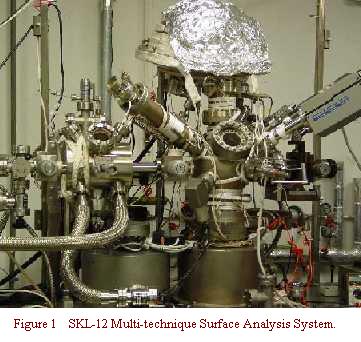
- SKL-12 spectrometer modified with
VG CLAM 4 multichannel hemispherical analyser
- Twin anode (Al/Mg) X-ray sources (no monochrometer)
- 5 keV Argon ion gun for sample cleaning
- UV lamp for UPS analysis
Limitation
- Samples must be solid and vacuum compatible
- Sample size : 6mm to 20mm in diameter
For further enquiry, please contact Mr. Benson Leung, Tel: (852)
34115876, email
scleung@hkbu.edu.hk